
Reflections on Death and Suicide
On breaking up with life

The following essay features frank discussion of suicide. Please approach with care.
This essay will remain free for a period of time. If you value my work, please consider becoming a paying subscriber or tipping my Ko-Fi at ko-fi.com/thaliavacha. Liking, commenting, and sharing the work also helps. Thank you for reading.
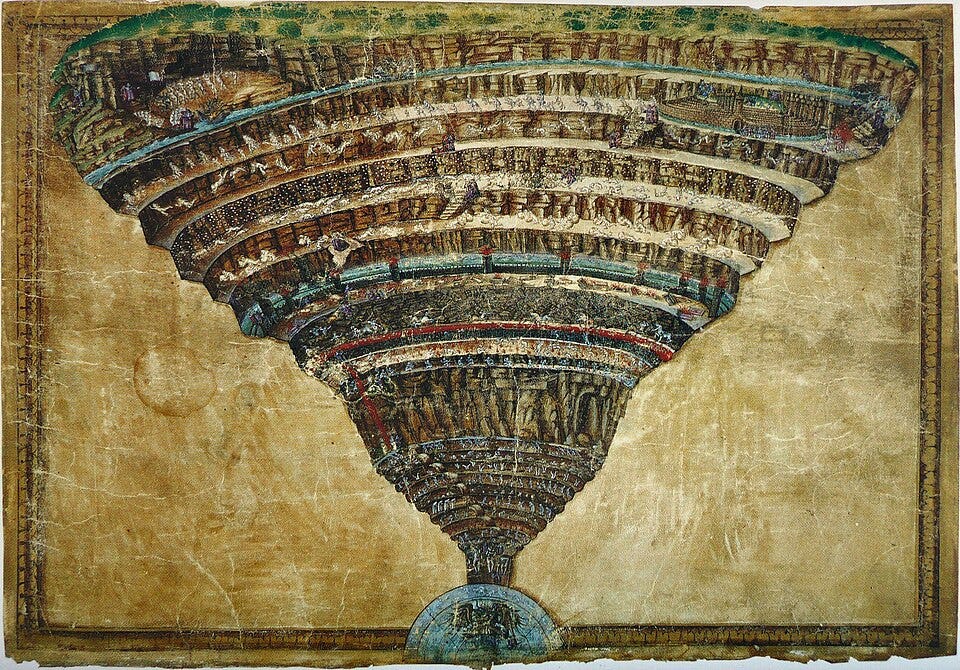
When I imagine death, I don’t imagine something akin to an eternal, dreamless sleep. A dreamless sleep is something I know. Death is something I don’t know. I have no concept of nothing. So when I think of death, I imagine something waiting for me. Whatever awaits me seems to terrify me enough that I insist on remaining alive. However attractive death might seem on the surface at times, I keep on breathing, breath after breath.
If life after death is nothing, and the death before life is also nothing, how did I ever break into this world? How could something without any spatiotemporal coordinates find its way into time and space? Everything that made me already was. The world rearranged itself into a new form, a form that could form memories. When I die, what ceases to exist but an tenporary configuration?
I don’t think there is any escape from life. We are all a part of it. We are none of us apart from it. Some non-religious people say they don’t fear death because they think they can make rational sense of it. They think of it as nothing, and nothing is no big deal. Yet they cling to life, able to point to the workings of atoms and the marvels of biology, speaking of models for life’s motions as if they spoke of life itself.
I fear death because I know I can’t make sense of it. I don’t know any principle of individuation, so how can I understand what happens with what seems like a self loses all integrity?
I once smoked 5-MeO-DMT. Undulating white light. People told me about experiences they had ‘breaking through.’ I don’t believe I broke through. I remained aware of my body, even if I was already somewhere else by the time my head hit the mattress. Tears streamed down my face. How could I have forgotten this? I asked myself. How can any of us have forgotten this?
Then I forgot whatever I’d remembered.
Don’t worry, I thought. By the time you get to return, it will seem as if no time has passed at all.
This is how I feel about the moment of death: It doesn’t matter how much time has passed, it will be as if none has passed at all.
I watched my mother die.
She drank from two paper cups in turn, each containing a different liquid. The first would prevent her from vomiting up the contents of the second. The second one would kill her.
She asked me, some time after drinking from the second cup, how much longer she had to wait before she died. I asked the nurse. The nurse told me it would be perhaps another five minutes. I told my mother it would be perhaps just another five minutes.
My mother said, “Too long.”
Iconic last words.
My mother was not afraid of death.
After another five minutes, her face turned a little grey. Her nose began to droop. Her head was at a tilt, so that her skin appeared to melt at an angle across it, a Dali clock. I watched as if I would somehow be able to see the exact moment of her death. I saw her move through a portal. I saw her remembering the place I had visited when I smoked 5-MeO-DMT, even though I would not smoke it until many years later. I saw her experience some moments of relief, as if a hand had reached through the portal and placed itself on her shoulder, with a voice breaking through from the other side: “You no longer have to hate yourself. You no longer have to suffer,” it said. “Welcome home.”
My mother has secondary progressive multiple sclerosis. By the time she had me, she was already battling chronic pain. She was certain only that the suffering would get worse. What was less certain was how. She might go blind. She might develop a persistent burning sensation in her spine. She might start to forget things. Every day was a lottery. Any symptom that emerged could be a momentary torment or a harbinger of the horrors to come.
I watched for two decades as her legs lost feeling and her mobility wavered. Her mobility was like a barometer for her readiness to die. She once woke up without any sensation below her waist. She dragged herself to the bathroom, swallowed several boxes of pills, and woke up in the hospital—still alive, fuck, a suicidal failure—some twenty-four hours later.
I’m sorry I’m so sorry I thought everyone would be OK I didn’t understand how it would hurt everyone so much I’m so sorry because in those moments I couldn’t think about I’m sorry about anything else I’m sorry but death.
I was twenty-three. I told her that if she wanted to die, I would rather be by her side. It took another eight years before I could tell her she only had five minutes left. She told us all, after that first time, that she regretted what she did. She never convinced me that she regretted anything but her failure.
“Too long.”
Someone once told me that a romantic breakup happens when two people in love no longer share a narrative. Under this rubric, a suicide is like a break up with life. Or with everyone and everything you know. But it’s not the kind of breakup you can deliver over text. You can try your best not to think. Or you can craft a narrative that gets you through it. I have a begrudging respect for those who succeed in taking their own lives. I imagine them facing death down. A triumph of agency, whichever way you look at it. A forceful expression of agency, sometimes, from someone whom the world has robbed of agency in almost every other domain.
We do what we need to to survive. Likewise, when we decide we need to die.
A few hours before I began writing this, I Googled the liquid that my mother drank from that second cup. I found it on the website of a US-based company. $394.00 for 200mg. Not bad. “THIS ITEM HAS BEEN IDENTIFIED AS A POTENTIALLY DANGEROUS GOOD,” the website warned. “SPECIAL SHIPPING METHODS AND CHARGES MAY APPLY.” But I didn’t order it. I’d have to import it. I’d have to figure out some way to cover my tracks. And besides, for all the loneliness I feel, for all my grief, my disabilities, my fears about the future, the dysphoria, the oppression, whatever else overwhelms me, I am still too afraid of death, and I still, despite myself, seem unable to extinguish that little light of hope that despite it all insists on burning within me.
Maybe this narrative of mine—that in death one risks becoming anything or everything else—is, in part, a way of keeping myself alive. I understand my mother’s gambit. Almost anything would be better than the unrelenting pain her body forced her to endure. But when I think of death like a lottery, I stop comparing myself just to other human beings. I don’t feel much affection for cockroaches. I certainly don’t envy them. I’m glad I wasn’t born one. But what if, somehow, as absurd as it seems, it still isn’t too late for that to happen? What if there’s a chance a cockroach life still awaits me? What if what appears to individuate me as one of the lucky few—the few who get to be human (because as numerous as we are, we still make up but a tiny fraction of the living)—is only an illusion?
What if the principle by which bits of the world reconstitute themselves as life is a complete and utter mystery?
It’s hard to claim that it isn’t.
Or at least, I find utility in thinking this way.
I once read a study that showed that many people who believe in karmic reincarnation will use it to justify unjust and unequal systems: If someone is of a low caste, they must have earned it through their past bad deeds. The wealthy elites must have done good to get there. Some people, believing in certain ideas about morality and hell, reject their own children for being queer or trans, insisting that the only way to save this child from hell is for the child to disavow something at the core of their being. Many people, also, will kill for the chance to enter paradise. Some will kill themselves, too, taking many others with them.
I don’t know what it means to believe in karmic reincarnation or in heaven or hell. These aren’t what scientists would call falsifiable beliefs. Nor is the equally mystical idea that what follows death is an intelligible nothing: this, as far as I am aware, is the only form of belief in life after death that treats the matter as one of certitude rather than faith, even if, as unfalsifiable as it is, it surely isn’t science. I don’t think a statement of belief is like a little box that contains some metaphysical entity called belief inside. To understand what someone believes, you might do better to watch how they live than to listen to what they say.
And if you watch how people live, it shows they believe so much more than they say they do about the meaning of life and death.
And you see how absurd it is to see any one person as a unity rather than a bundle of contradictions. The multitudes a person contains never reconcile into a cohesive whole. A mother’s hand brings a paper cup to her lips of the liquid that will kill her. Her lungs, nonetheless, keep breathing. On social media and on society at large, people will hound you into a corner of consistency. “I contradict myself? Very well then I contract myself. (I am large. I contain multitudes).”
I try to imagine what I might believe by watching how I live. Unlike many, I don’t believe I have direct access to my own beliefs. I accept myself as a hypocrite, because I accept myself as human.
Lately, I have been thinking a lot about death, telling myself I want it for myself, greedy for it. I want some respite from this chronic pain. I want a resolution to the grief of exile. I want relief from what I sometimes see as the nightmare of being a trans woman in this world. The world is a nightmare from which I often feel a desperation to wake up matched only by the list I feel at the peak of my cycles of sexual arousal.
But after I googled the drug that killed my mother—or that my mother used to kill herself—I didn’t even reach the checkout page.
Not this time. Maybe not ever.
I have, in the past, got further along. I have bought instruction manuals and equipment. I’ve had everything prepared. I had been in far scarier situations than anything I am dealing with now. My life at present is perhaps the most comfortable and hopeful it has ever been. But I insisted, in those instances, on living nonetheless.
Some people today say every trans suicide is a murder of the state. Maybe I just don’t want my enemies—who see me much as they see a cockroach—to have their way.
My greatest fear is ending up in the situation my mother foresaw for herself when she woke up without feeling beneath her waist: What if I end up in long-lasting agony with no means of escape? As a survivor of torture and botched surgeries and as someone who lives with chronic gastritis, arthritis, depression, and generalized anxiety, this is a domain of life with which I am far too intimate. I want to say I fear it more than death itself. But here I am, still risking the possibility because the present still feels safer than what death might bring. And I love, despite myself. Nothing can compensate for all the pain in the world, but the opportunity to bring the slightest amount of relief to those facing unimaginable suffering seems almost miraculous. The fact my words can sometimes or the attention I offer my friends can do this makes me feel so lucky to be alive. It reminds me that the world is not an abstraction but something the visceral reality of which pushes through whatever attempts I make to abstract it through my reflections.
I’m grateful that everything is impermanent. I may be powerless to keep the worst at bay, but I am just as powerless to keep the worst from passing.
Maybe, one day, I’ll be a cockroach, but another day, I’ll die again, to live yet another day. By the time I get to die again, it will seem as if no time has passed at all.
So I carry on, indulging each day in the madness of believing I can make whatever meaning I will, while knowing, also, that whatever happens, that nothing ever fails to leave a trace, every thing dies, and even with the heat death of the universe or the big crunch or the proliferation of new universes everywhere all at once, when it finally arrives, with no creature left to witness it, it will be as if no time has passed at all.
For more about my mother’s death, you can read Boundaries or The Switzerland Schedule. The last time I was a suicide risk, I tried to write my way out of it. I published the results as An Anti-Suicide Note.
If you value my work, please consider upgrading to a paid subscription or tipping my Ko-Fi at www.ko-fi.com/thaliavacha. I devote a tremendous amount of time and energy to this Substack, and I would like to earn enough from it that I can keep doing so in the long run. I am about 1/4 of the way from making that dream come true.
It also helps to like, share, and comment. Thank you for reading and supporting.
This is POWERFUL!!My deepest sympathy on your mother's illness and you having to watch her suffer and be with her taking death in her terms! You are so very kind, brave and so very loving to be with her every step of the way!
As someone who deals with deep depression and has been suicidal (the last 3 times were 14 mono ago) your post spoke volumes to me!
You are a talented writer and gently firmly brought up thoughts that need be evaluated and sorted out in each of our hearts Your post was both sensitive and thought provoking! I am still absorbing what I just read!✍️! I want to read as much of your work as I can but it did trigger me a bit!
This is powerful, Thalia. Thank you. Thinking about death directly can definitely be a relief from the social prohibition that we acknowledge its inevitability!